The era of the hammer and nail is being rewritten by algorithms. While the wood pallet remains the backbone of logistics, the intelligence behind its creation is transforming. Pallets are getting smarter as data evolves. Adopting artificial intelligence isn’t a luxury; it is a survival mechanism.
According to a study, AI and Machine Learning integration in manufacturing improves operational efficiency by 18% and decreases energy consumption by 7%, while reducing downtime and maintenance costs (Jin et al., 2025).
For Canadian logistics managers, this shift represents the difference between reactive firefighting and proactive dominance.
AI-Driven Quality Control, Production & Planning, and Waste Management
In traditional manufacturing, these 3 pillars operated in isolated silos. AI has unified them into a synchronized ecosystem where data flows instantly from the saw blade to the shipping dock.
1. Quality Control: The Unblinking Eye
Quality control used to be a subjective art, dependent on a human inspector. AI-driven computer vision systems have changed the standard by eliminating the variable of human fatigue.
- Automated Defect Detection: High-speed cameras paired with machine learning algorithms scan every board of lumber before it enters the assembly line. These systems identify structural weaknesses that the human eye might miss at production speeds.
- Dimensional Integrity: Beyond surface defects, AI systems measure board dimensions to the sub-millimetre. This ensures that every pallet produced is automation-ready, capable of running through your robotic palletizers without causing jams or downtime.
2. Production and Planning: Dynamic Agility
Static production schedules fail when urgent orders disrupt the flow. AI algorithms revolutionize planning by treating production as a dynamic fluid rather than a rigid calendar.
- Generative Design Integration: Before production begins, AI-driven generative design software can simulate thousands of configurations. It solves for the perfect balance of strength and material usage, creating a “digital twin” of the pallet that is then fed directly to the manufacturing line.
- Optimized Changeovers: If a sudden order for custom pallets arrives, the AI calculates the optimal moment to switch the line over to minimize downtime. It balances the urgency of the new order against the efficiency of the current run.
3. Waste Management: Maximizing Yield
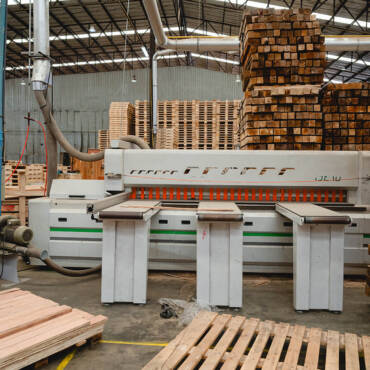
In a country like Canada, where natural resource stewardship is important, waste reduction is critical. Smart saws equipped with AI do not just cut wood; they optimize it.
- Yield Optimization: The system calculates the most efficient cut for every log in milliseconds. It fits the required board dimensions into the raw timber geometry to ensure maximum yield from every tree.
- Closed-Loop Sorting: In recycling operations, AI-guided robotic arms can now sort returned pallets automatically. Computer vision instantly assesses if a pallet is an A-grade, a repairable B-grade, or scrap. This eliminates manual sorting bottlenecks and ensures that every usable board is rescued from the grinder.
Using AI for Predictive Maintenance
Unplanned downtime is the silent killer of profitability. In the dead of winter, if a primary nailing machine shears a bolt or a hydraulic pump freezes, production stops. Shipments get delayed. The ripple effect hits your dock within hours, potentially stalling your own outbound logistics.
Predictive maintenance shifts the paradigm from “fix it when it breaks” to “fix it before it falters.”
- Vibration and Acoustic Monitoring: Sensors embedded in manufacturing equipment monitor vibration, temperature, and acoustic signatures. AI analyzes this stream of data to detect the microscopic anomalies that precede a failure. A bearing beginning to grind sounds different to an AI long before it emits smoke or heat.
- Cold-Weather Resilience: This is vital in Canadian winters. AI models can adjust hydraulic pressures and machine speeds based on ambient temperature readings, preventing the “cold start” damage that often plagues heavy machinery in unheated environments.
- Pre-Emptive Alerts: The system alerts maintenance teams to replace a specific part during a scheduled shift change rather than in the middle of a rush order. When your supplier uses AI to maintain their uptime, they are effectively guaranteeing yours. Reliability becomes a mathematical certainty rather than a promise.
Optimized Inventory Management with AI by Estimating Supply and Demand
The old model of inventory management was simple: buy heavily and store it. However, warehouse space in the GTA is expensive, and capital tied up in static wood is capital that cannot be used elsewhere.
AI reshapes inventory management by replacing guesswork with high-precision demand forecasting. This transforms how wooden pallets in Mississauga are sourced, moving from a reactive model to a predictive one.
Deep Data Analysis
AI algorithms do not just look at what you bought last year; they look at the world around you. By analyzing historical sales data, seasonal trends, and even external factors like housing construction starts, agricultural yields, or currency fluctuations, AI estimates supply and demand with frightening accuracy.
- Seasonal Anticipation: The system recognizes that a spike in agricultural output in August requires a ramp-up in lumber procurement in June. It triggers raw material orders weeks in advance, ensuring the stock is curing in the yard long before you place the phone call.
- Market Volatility Protection: The lumber market is notoriously volatile. AI helps suppliers buy smart, identifying dip patterns in lumber prices to stock up on raw materials at the lowest cost. These savings stabilize the price per unit for you, even when the broader market is fluctuating.
Proactive Procurement
For the logistics manager, this means the end of “out of stock” notifications. Your supplier knows what you need before you place the order. They can hold dedicated safety stock based on your predicted usage, allowing you to operate with a “Just-in-Time” model without the fear of stockouts.
You get the pallets you need, exactly when you need them, without drowning in inventory during slow months. It turns the supplier-client relationship into a partnership where data bridges the gap between your production line and their sawmills.
Secure Your Logistics with Intelligence

The future belongs to operations that value precision over volume. As the gap widens between traditional manufacturers and tech-enabled partners, the choice becomes clear. You need a supplier who invests in the technology that protects your bottom line.
Don’t let your supply chain rely on outdated methods. Choose a partner who uses the power of advanced manufacturing to deliver consistency, quality, and reliability every single time.
Smart Manufacturing Starts with Woodbridge Pallet
Your business deserves a partner who is ahead of the curve. For a reliable, forward-thinking pallet supplier in Mississauga that combines industry experience with operational excellence, we are ready to serve.
Contact Woodbridge Pallet today at 1-800-361-7798. Let’s build a smarter, stronger supply chain together.